

The Concentration Problem: Big Tech's Grip on Global Indices
As the combined weighting of a handful of Silicon Valley giants quietly surpasses that of entire sovereign economies within global benchmark indices, the passive investment strategies favored by institutional allocators are increasingly functioning as compulsory vehicles for concentration risk rather than diversification. For family offices, sovereign wealth funds, and high-net-worth portfolios benchmarked against the S&P 500 or MSCI World, this structural distortion demands not merely awareness, but an urgent recalibration of how capital is deployed across asset classes.…

When seven companies account for more than 30% of the world's most widely tracked equity index, the word "diversification" begins to lose its meaning. Apple, Microsoft, Nvidia, Alphabet, Amazon, Meta, and Tesla — the so-called Magnificent Seven — have become one of the defining structural tensions in global asset allocation. For family offices in Riyadh, sovereign-adjacent investors in Abu Dhabi, and private wealth managers from Nairobi to Jakarta, this concentration stopped being an abstract concern some time ago. It is a live portfolio problem. And the window to address it is narrowing.
The Index Is Not the Market
For two decades, the mechanical logic of passive investing has functioned as the dominant religion of institutional capital. Buy the index, capture broad economic growth, minimise fees. Clean. Simple. Defensible in any investment committee. But the index has quietly transformed into something its early architects never intended: a leveraged bet on a handful of American technology companies. As of early 2026, the top ten holdings of the MSCI World Index represent roughly 24% of its total weight, with American mega-cap tech absorbing the lion's share. An investor who believes they hold "the global market" through a standard passive vehicle is, in practice, sitting on a concentration position that would raise flags in any serious risk review.
The distortion compounds. Passive inflows into US-listed ETFs have accelerated buying in precisely the stocks already carrying the heaviest index weight, creating a self-reinforcing cycle with a predictable endgame. When institutional money rotates — and it will — the unwind will be asymmetric. The stocks that rose fastest on passive inflows will fall fastest when redemptions arrive. That is not a theory. It happened in 2022, when the Magnificent Seven collectively shed over $4 trillion in market capitalisation across twelve months, dragging indexed portfolios globally into significant drawdown. The mechanism was visible to anyone paying attention.
Saudi Arabia's Opening Creates a Timely Alternative
Against that backdrop, the Saudi Arabian Capital Market Authority's decision to eliminate the Qualified Foreign Investor framework — effective February 1, 2026 — carries strategic weight well beyond the headlines it generated. For the first time, smaller institutional investors and qualified retail participants can access Tadawul-listed equities directly, bypassing the previous $500 million AUM threshold that had restricted entry to only the largest global institutions. That is a meaningful structural shift in how capital can reach one of the world's most liquid emerging market exchanges.
The timing matters. Analysts at Jefferies estimate that passive inflows alone could reach between $3.4 billion and $10.2 billion if the current 49% aggregate foreign ownership cap is eventually lifted — a review scheduled for later this year. But the more compelling argument is compositional. Tadawul's sector mix delivers what Big Tech-heavy indices cannot: genuine exposure to energy infrastructure, petrochemicals, banking, and real estate. For a family office managing a $200 million portfolio with 40% passively indexed to US equities, adding direct Saudi exposure is not simply geographic diversification. It is sectoral and structural diversification of the kind that actually moves the correlation needle.
Institutional Behaviour in Volatile Conditions
Earlier this year, the Tadawul All Share Index offered a real-time case study in how locally anchored capital behaves under geopolitical stress. Saudi institutional investors — who had been net sellers of $7.5 billion in domestic equities from the start of 2025 through to the end of February 2026 — reversed course sharply as tensions with Iran escalated. Their coordinated buying drove the TASI up 5% in March, a period when most global equity markets were experiencing elevated volatility and indiscriminate selling. Few outside the region noticed. They should have.
Julian Bruce, Managing Director of EFG Hermes' UAE brokerage, noted that the Saudi market had been significantly undervalued heading into that period, and that rotation from UAE into Saudi equities — particularly in the banking sector — reflected a genuine valuation argument rather than panic-driven flows. That distinction matters. A market where informed domestic institutions step in as buyers during external shocks is a market with a functioning price-discovery mechanism. That is increasingly difficult to find in indices where passive flows have crowded out fundamental analysis entirely. The numbers tell a complicated story, but the direction of travel is clear.
Deal Flow, IPOs, and the Private Capital Angle
The concentration problem in public markets has a direct read-across to private capital. As Big Tech dominates public indices, venture and growth equity valuations for technology companies have stayed elevated, compressing returns for late-stage private investors. Family offices and sovereign-adjacent allocators who accumulated technology exposure through private placements in 2020 and 2021 are now sitting in a difficult exit environment — IPO windows narrowed, public market comparables under pressure, and sponsors reluctant to mark books to reality.
The Gulf's private deal pipeline is a different story. HSBC currently holds 45 merger, acquisition, and IPO mandates across the Gulf region. Selim Kervanci, HSBC's regional chief for the Middle East, North Africa and Turkey, has indicated that deal flow recovery depends on at least one full quarter of regional stability following the Iran conflict — pointing toward a Q4 2026 acceleration. That pipeline spans infrastructure, contracting, financial services, and consumer sectors. These are precisely the industries absent from or underweight in technology-dominated global indices. For private investors and family offices with patient capital and regional networks, the current quiet in deal activity is a positioning window, not a warning sign.
What Sophisticated Allocators Are Doing Differently
The investors best placed to come through the current concentration cycle are those who long ago treated index exposure as a starting point rather than a destination. Across the Gulf, Central Asia, and Southeast Asia, a cohort of family offices managing between $50 million and $500 million have been quietly building direct equity positions on domestic exchanges — Tadawul, Boursa Kuwait, the Abu Dhabi Securities Exchange — alongside selective allocations to African infrastructure debt and Indonesian consumer equities. These are not exotic plays. They are rational responses to a structural distortion that mainstream allocators have been slow to acknowledge.
The Magnificent Seven are not going to voluntarily shrink their market capitalisations. Passive fund managers are not going to cut their weightings until the indices themselves are rebalanced by market forces. That rigidity, for private investors and family offices with the flexibility to allocate outside standard benchmarks, is an advantage worth exploiting. Tadawul's full opening, the Gulf's recovering IPO pipeline, and the sectoral depth of emerging market exchanges from Casablanca to Ho Chi Minh City represent a genuine alternative to index concentration. The opportunity rewards early positioning. It punishes complacency.
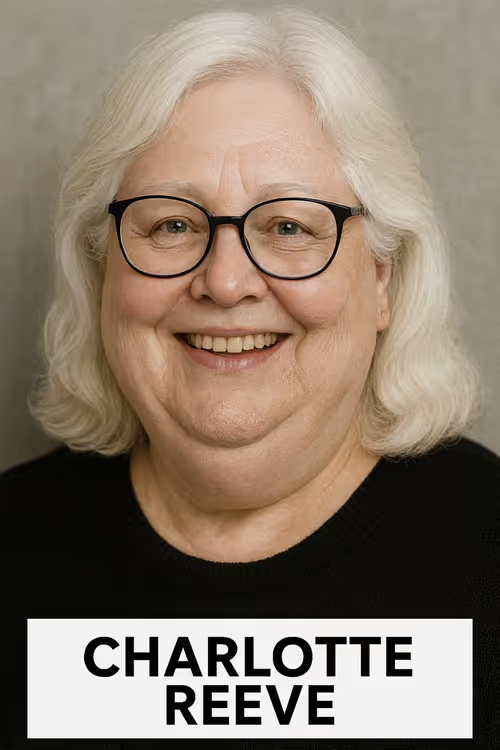
Written by
Charlotte Reeve
Senior correspondent · Capital Markets & Fintech
Charlotte cut her teeth on an equities desk before moving to the other side of the notebook. She covers capital markets, stock exchanges, and the fintech operators trying to disintermediate the banks that trained her. Sharpest on market microstructure and payments infrastructure; still reads a prospectus for fun. Based in Singapore. Reach out at charlotte.reeve@theplatinumcapital.com.