

The Earnings Season Reality Check: Beats, Misses, and Guidance
As earnings season unfolds, the gap between headline beats and the underlying quality of corporate results has never demanded more rigorous scrutiny, with seasoned investors increasingly separating performative revenue optics from the harder truths buried in forward guidance and margin compression. For family offices and institutional allocators navigating today's rate-sensitive environment, the difference between a company that merely clears a lowered bar and one that genuinely accelerates earnings power is precisely where portfolio outcomes diverge.…

Earnings season has never been a simple ledger of beats and misses. For the sophisticated investor — whether managing a family office in Dubai, allocating capital from Riyadh, or overseeing a multi-asset portfolio from Kuala Lumpur — what matters far more than last quarter's numbers is what management chooses to say about the quarters ahead. In 2026, that guidance carries unusual weight. Gulf equity markets are undergoing structural transformation, geopolitical risk is receding faster than most analysts predicted, and capital is actively searching for new homes.
The Beat That Doesn't Tell the Whole Story
The headline number looks good. Approximately 73% of S&P 500 companies reporting through mid-year have beaten consensus earnings-per-share estimates. But the quality of those beats deserves hard scrutiny. A meaningful portion of outperformance has been driven by cost reduction rather than revenue growth — a distinction that sophisticated allocators do not miss. When a company beats by cutting headcount and deferring capital expenditure, it is borrowing from future capacity. It is not building anything.
Emerging markets tell a more textured story. Banks across the Gulf Cooperation Council have broadly posted solid first-half results, underpinned by sustained net interest margins and resilient loan books. Saudi lenders, in particular, have benefited from continued corporate credit demand tied to Vision 2030 infrastructure delivery. Yet guidance has been cautious on deposit costs and fee income diversification. Management teams are watching the macro environment carefully, even as the structural growth story holds. That combination — solid results, hedged outlook — tells you something about where confidence actually sits.
Tadawul's Open Door and What It Means for Price Discovery
The single most consequential development reshaping how earnings are read and valued across the region is Saudi Arabia's abolition of the Qualified Foreign Investor regime, effective February 1, 2026. For the first time since Tadawul opened to foreign participation in 2015, both institutional and individual investors from any jurisdiction can access the Main Market directly — no qualification thresholds, no regulatory friction that historically dampened participation. The market's $2.7 trillion capitalisation is now, structurally, a global market. Full stop.
The immediate response was instructive. In January alone, foreign investors were net buyers of approximately SR 5 billion — roughly $1.33 billion — the strongest monthly foreign buying in nearly four years, accounting for 41.7% of total market purchases. That is not speculative momentum. That is institutional allocation in motion. It also means that earnings reports from listed Saudi companies now face a far wider analytical lens. Foreign buy-side teams with no prior obligation to hold Saudi names are pricing these stocks. They will apply their own earnings quality frameworks, their own guidance credibility tests. For Saudi-listed companies, the bar for transparent and credible forward guidance has risen materially. The room just got larger and the audience more demanding.
Guidance Credibility in a Post-Conflict Market
Perhaps the most significant variable affecting how guidance is being interpreted across Gulf equity markets in mid-2026 is geopolitical. The signing of the US-Iran memorandum of understanding — a 14-point accord that effectively ended the period of active regional conflict — triggered an immediate re-rating of risk across Abu Dhabi and Dubai equities. Both the Abu Dhabi Securities Exchange and the Dubai Financial Market climbed to their highest levels in three months on the news. Deal-flow sentiment shifted almost overnight. That is a significant shift.
HSBC's regional chief for the Middle East, North Africa and Turkey, Selim Kervanci, has been direct about what comes next. With a pipeline of 45 M&A and IPO mandates across the Gulf, Kervanci has indicated that equity capital markets activity is expected to resume meaningfully in the fourth quarter of 2026 — but he has been equally clear that restoring full investor confidence and deal execution velocity requires at least one full quarter of sustained calm. For companies preparing to list, and for investors evaluating forward guidance from those already listed, that timeline matters. The market's risk premium is compressing. It is not yet fully normalised.
The withdrawal of Mutlaq Al Ghowairi Contracting Company from its planned Tadawul listing, announced on June 9 after consultation with financial advisors, is a useful data point here. Read it carefully before drawing the obvious conclusion. This is not a signal of weakness in the broader IPO market — it reflects the pricing discipline that issuers are being asked to exercise when institutional investors are calibrating entry points with unusual care. In an environment where guidance credibility is under the microscope, pulling a deal at the right moment is a considered act. It is not a failure.
What Misses Are Actually Saying
The companies that have missed estimates this cycle have done so in ways that expose genuine pressure points. Consumer-facing businesses in markets where purchasing power has been squeezed — parts of North Africa, certain Southeast Asian economies, mid-tier retail across Europe — have reported revenue shortfalls that reflect real demand softness. Not conservative consensus estimates. Real softness. Energy-adjacent businesses in the Gulf have faced a separate complexity: oil price volatility alongside project delivery timelines that are, in some cases, running ahead of budget and behind schedule simultaneously.
More revealing than the misses themselves is how management teams have framed them. The numbers tell a complicated story, but the language tells a clearer one. Companies that acknowledge demand weakness with specificity, offer revised guidance with clear assumptions, and outline concrete responses tend to be rewarded — or at least not punished — by sophisticated investors. Those that blame macro conditions broadly, while offering vague reassurances about the second half, tend to see sharper de-ratings. For family office principals evaluating direct equity positions in listed regional companies, the quality of a management team's earnings communication is itself an investment signal. Sometimes it is the most important one on the page.
The Forward View: Positioning for What Guidance Is Actually Pricing
For wealthy investors and family offices with exposure to Gulf and broader emerging market equities, the current earnings season is offering a cleaner signal than most recent cycles have managed: the bifurcation between companies with genuine earnings momentum and those running purely on cost discipline is becoming visible. Tadawul's structural opening to global capital will accelerate that differentiation. As HSBC's 45-mandate pipeline moves toward fourth-quarter execution — assuming the geopolitical calm holds — deal activity will return, valuations will be stress-tested against fresh comparables, and guidance issued today will be held to account by a more demanding, more globally diverse shareholder base.
The investors who will position most effectively are those who read guidance not as a management promise but as a statement of institutional confidence. In markets where that confidence is being rebuilt in real time, earnings season is less a report card and more an early indicator of what the next twelve months will actually reward. The sophisticated money is already reading it that way.
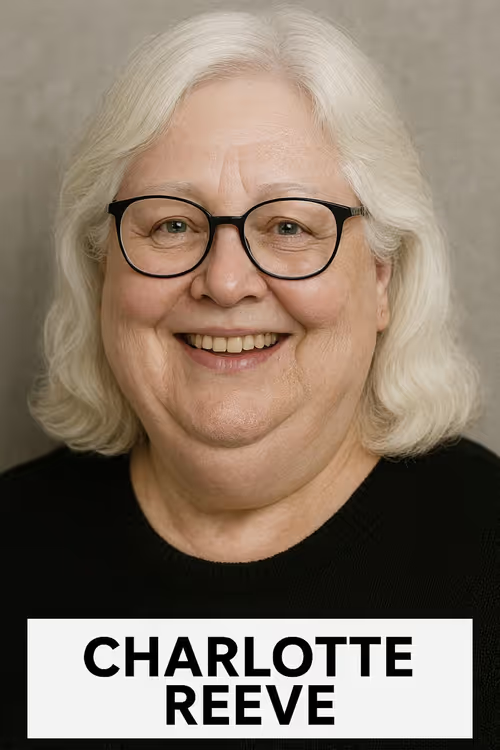
Written by
Charlotte Reeve
Senior correspondent · Capital Markets & Fintech
Charlotte cut her teeth on an equities desk before moving to the other side of the notebook. She covers capital markets, stock exchanges, and the fintech operators trying to disintermediate the banks that trained her. Sharpest on market microstructure and payments infrastructure; still reads a prospectus for fun. Based in Singapore. Reach out at charlotte.reeve@theplatinumcapital.com.