Private Placements in the Gulf: Capital Without the Public Glare
As sovereign wealth funds and ultra-high-net-worth families across the Gulf increasingly seek to deploy capital outside the scrutiny of public markets, private placements have emerged as the instrument of choice for transactions where discretion is as valuable as the return itself. From Riyadh to Abu Dhabi, a quiet but accelerating shift is reshaping how regional capital is structured, negotiated, and ultimately put to work — far beyond the reach of exchange floors and regulatory disclosure windows.…
Gulf equity markets are having their quietest IPO year since 2021 — first-time share sales have fetched just over $1 billion region-wide. But a parallel capital market has been running alongside the public slowdown, operating with considerably less friction and considerably more discretion. Private placements across the GCC have become the preferred instrument of serious capital deployment: structured quietly, closed quickly, and shared only with those already in the room. For family offices, sovereign-adjacent investors, and UHNW principals across the Gulf and beyond, the private placement market is not a fallback. It is, increasingly, the first call.
The Public Market Slowdown Is Redirecting Flow, Not Destroying It
The numbers from the public markets tell a story of hesitation. HSBC's Middle East, North Africa and Turkey unit currently holds 45 M&A and IPO mandates — and has signalled that meaningful listings are unlikely before Q4 2026. Selim Kervanci, HSBC's regional chief for MENA and Turkey, has been explicit: at least one full quarter of stability is needed before equity capital market activity normalises. Then came the Mutlaq Al Ghowairi Contracting Company episode — a planned Tadawul listing pulled at the last minute in June, after consultations with financial advisers made the public exposure look more trouble than it was worth. That is how cautious issuers have become.
What the slowdown has done is concentrate deal activity into private channels. Sponsors, developers, and mid-market operators who might have tested the public markets 18 months ago are instead approaching pre-selected investor pools directly. For qualified investors, this shift represents real opportunity: terms are more negotiable, pricing more competitive, and access far less commoditised than anything that reaches a prospectus.
Sovereign Appetite Is Setting the Tone
Look at what has been happening in the bond markets. Saudi Arabia's Public Investment Fund raised $7 billion in May through a three-tranche dollar offering — 3-year, 7-year, and 30-year — with an order book that peaked at $23.8 billion. The 30-year tranche alone priced at 6.25%, with spreads of +135 basis points over US Treasuries, absorbing $2.5 billion from investors who were clearly comfortable sitting on long-duration Gulf sovereign risk.
Bahrain reinforced the point even more sharply. The kingdom — the GCC's most fiscally constrained sovereign, which required a UAE currency swap facility of approximately $5.5 billion to stabilise its bonds as recently as April — still managed to draw $3.2 billion in orders for a $1 billion 10-year note in July 2026, pricing the yield down from 7.5% guidance to 7.125%. When even the region's most stretched sovereign achieves that kind of oversubscription, the signal is hard to miss. Deep, patient capital is sitting in this region, actively searching for structured, yield-generating exposure. Private placements are often exactly where that capital lands when public windows are closed.
What Private Placements Actually Look Like in the Gulf
The mechanics vary considerably depending on jurisdiction, sector, and issuer profile. But several structures have become standard among serious arrangers. In the UAE, exempt offerings under the Securities and Commodities Authority's qualified investor framework allow issuers to raise capital from up to 200 institutional or sophisticated investors without full prospectus requirements. Saudi Arabia's Capital Market Authority runs a similar exemption architecture — particularly favoured by real estate developers, private credit vehicles, and infrastructure-adjacent issuers who would rather keep things simple than keep things visible.
Sukuk structures remain dominant for Gulf-domiciled issuers seeking Sharia-compliant capital. Ajman Bank's issuance of its first-ever Additional Tier 1 sukuk in July 2026 — a genuine first for that institution — shows how even second-tier GCC banks are now using private Islamic instruments to shore up capital ratios away from the public gaze. For family offices based in Dubai or Abu Dhabi weighing credit exposure to regional financial institutions, AT1 sukuk placements from issuers like Ajman Bank represent exactly the kind of yield-premium opportunity that never surfaces in a Bloomberg screener.
Who Is Actually Placing — and Who Is Buying
The issuer base has broadened considerably. The market was historically dominated by banks and property developers. Now it includes logistics operators, healthcare platforms, technology-enabled financial services firms, and holding companies managing multigenerational family assets that need liquidity events without triggering public disclosure. Several prominent UAE-based conglomerates have used private note placements to refinance legacy debt or fund acquisitions across Africa and Southeast Asia — regions where their operational footprints are expanding, but where public market scrutiny would complicate the negotiations.
On the buy side, the composition is equally diverse. Gulf family offices — particularly those managing assets in the $50 million to $500 million range — have emerged as consistent anchor investors in mid-market private placements, often co-investing alongside regional private equity managers or development finance institutions. Investors from Kazakhstan and Uzbekistan, increasingly present in Dubai's financial free zones, have been active in Sharia-compliant structures. Few outside the region have noticed. They should. Nigerian and Egyptian family capital, often managed from London or Geneva but increasingly repatriated into UAE-registered vehicles, has found private placements an effective way to gain regional fixed income exposure without absorbing currency volatility risk.
Forward Positioning: What Sophisticated Investors Should Watch
The second half of 2026 sets up a specific, time-sensitive window — one that rewards preparation over reaction. With HSBC's pipeline of 45 mandates likely to produce a concentrated burst of public activity in Q4, the pre-IPO private placement market — where early investors take structured positions in companies ahead of public listings — will be particularly active in the coming months. Issuers who delayed public offerings are not disappearing. They are raising bridge capital privately while they wait for conditions to stabilise.
Investors with direct relationships with regional arrangers — including the investment banking arms of First Abu Dhabi Bank, Saudi National Bank, and QInvest in Doha — will see deal flow that never reaches the wider market. That is not a minor distinction. For family office principals weighing credit exposure in a higher-for-longer rate environment, Gulf private placements currently offer a rare combination: regional familiarity, structural flexibility, Sharia compatibility where required, and yield levels that public markets in the same geography simply cannot match. The capital is here. The deals are moving. The only requirement is knowing where to look — and being known well enough to be invited.
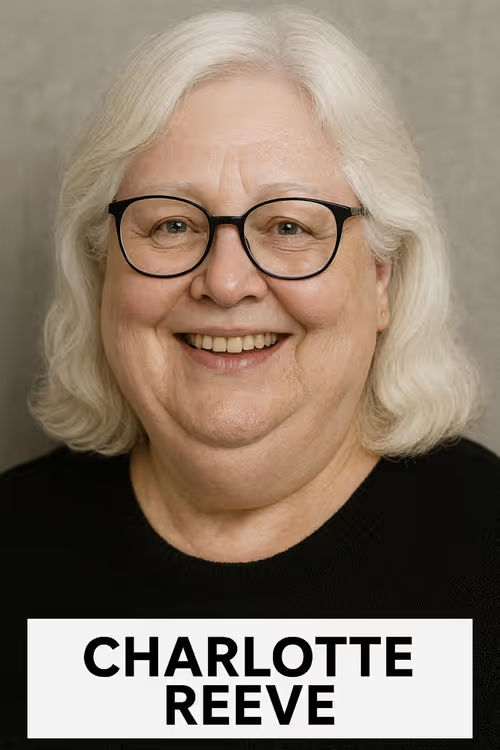
Written by
Charlotte Reeve
Senior correspondent · Capital Markets & Fintech
Charlotte cut her teeth on an equities desk before moving to the other side of the notebook. She covers capital markets, stock exchanges, and the fintech operators trying to disintermediate the banks that trained her. Sharpest on market microstructure and payments infrastructure; still reads a prospectus for fun. Based in Singapore. Reach out at charlotte.reeve@theplatinumcapital.com.